
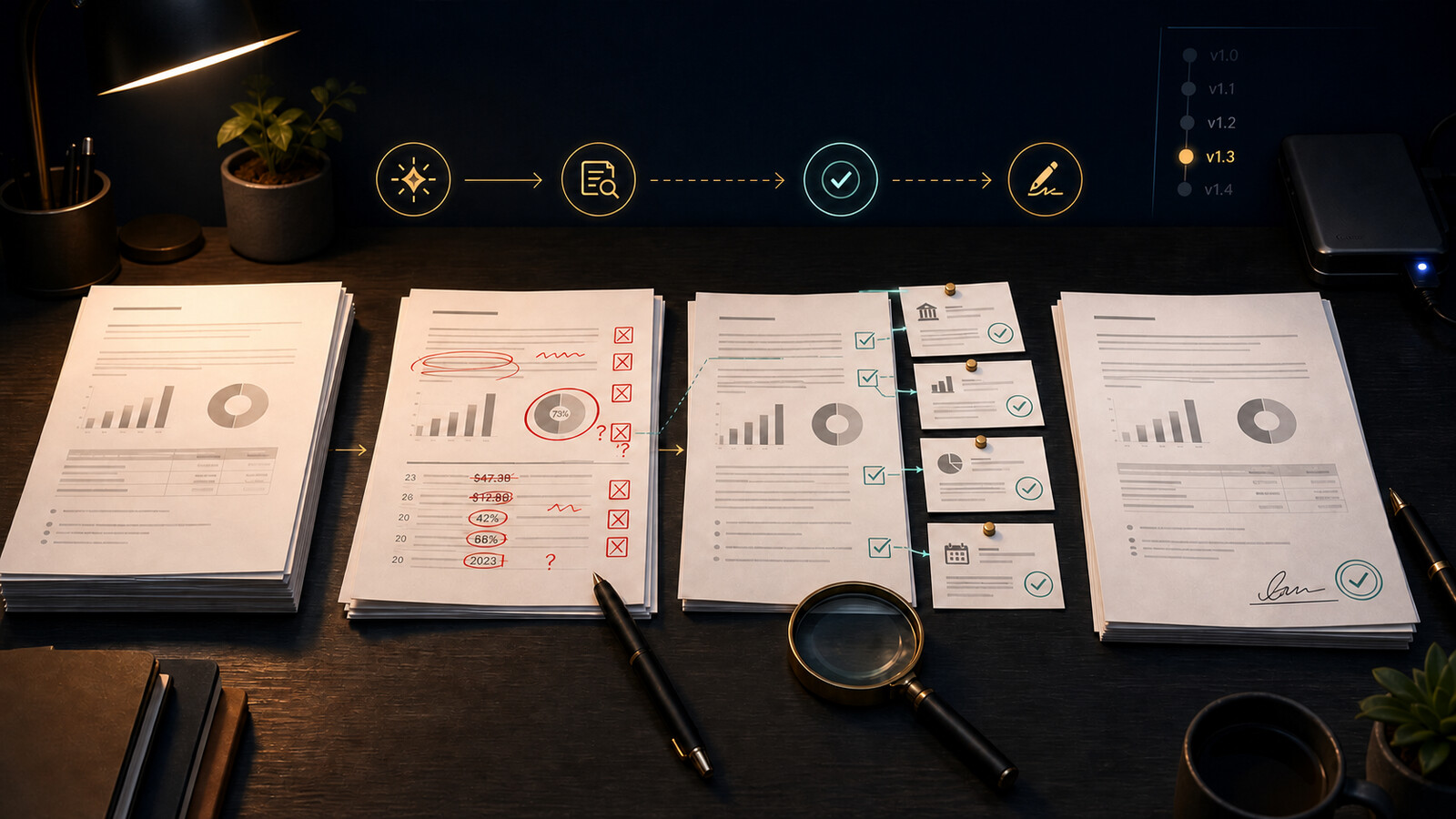
You can delegate the first draft. You can’t delegate responsibility for what you sign, file, publish, or turn into a decision.
TL;DR
Artificial intelligence can research, summarize, compare, draft, and speed up much of the work. That doesn’t turn fluency into truth or transfer responsibility to the machine from the person using its output. Real cases in the courts and the press reveal a similar chain: AI generates, someone checks only the appearance, someone else signs, and the institution publishes. Reviewing isn’t giving something a quick read before sending it. It means checking assumptions, sources, numbers, limits, and consequences. Authorship doesn’t end when the machine writes the first draft; that’s precisely where the obligation to decide what deserves to survive begins.
“You wrote it, didn’t read it—and then it came back to bite you.”
My generation heard that warning before artificially generated text existed. It applied to exams, contracts, notes, forms, and any other situation in which the pen moved faster than attention.
AI hasn’t made the warning obsolete.
It has given it infrastructure.
Today, a first draft can arrive in seconds, complete with a title, subtitle, table, reference, professional tone, and a conclusion so confident it practically begs to be signed. The text doesn’t look like a draft. It looks like a decision that has already been made.
That’s where the risk lies.
The problem isn’t that the machine writes. The problem is someone mistaking a well-written answer for finished work.
The imprecise memory already held the thesis
This text began with an incomplete memory.
I remembered a case in which “a lawyer, or perhaps a prosecutor” had used AI in a draft based on a nonexistent or legally impossible premise. The details were mixed up.
It would have been easy to fill the gaps with the most convenient version and keep writing. It would also have been an accidental demonstration of the very problem I wanted to expose.
So we checked.
The Brazilian episode that best matches my memory of the draft involved the Federal Regional Court of the 1st Region. In 2023, a signed judicial decision contained precedents that didn’t exist. The court’s inspector general’s office recorded that a generative AI tool had been used to assist in preparing the draft and had produced false references.
The most important point in the circular isn’t the tool’s name. It’s responsibility: supervision and verification remain the duty of the person accountable for the judicial act.
The Brazilian National Council of Justice report on generative AI in the judiciary uses the episode to discuss a risk known as automation bias: our tendency to place too much trust in a system’s output, especially when it arrives quickly, neatly organized, and with an appearance of precision.
The source supports the existence of the incident and the risk of excessive trust. It doesn’t prove that every AI-assisted decision will be wrong, nor that the judge personally wrote the prompt that generated the references.
That distinction matters. Responsibility doesn’t require inventing a more scandalous version of the case.
The lawyer who checked the grammar but not the law
The best-known case happened in the United States.
In Mata v. Avianca, a lawyer used ChatGPT to research decisions that would support a court filing. The tool supplied nonexistent cases, fabricated citations, and passages attributed to courts that had never written them. Another lawyer signed and filed the document.
According to the court’s June 22, 2023 sanctions order, the document was reviewed for form, style, and grammar. The cited legal authorities were not checked. Even after opposing counsel and the court questioned whether the cases existed, the correction didn’t come with the necessary speed and transparency.
The lawyers and their firm received a joint $5,000 penalty and had to notify both the client and the judges falsely presented as authors of the fabricated decisions.
The court itself drew a distinction that tends to disappear from headlines: using AI as an aid isn’t inherently improper. The sanction didn’t arise simply because a lawyer had chatted with ChatGPT. It arose from the lack of verification, the persistence after warnings, and misleading statements made to the court.
Nor is it accurate to say that the underlying case was lost “because of AI.” The main dispute had a different legal outcome. What this case demonstrates is more specific and more useful: reviewing how a text looks isn’t the same as reviewing its substance.
Ten books that didn’t exist made it through an entire chain
The law makes the risk dramatic because someone signs and files the document. In publishing, the chain can be longer—and for that very reason, responsibility can seem to belong to no one.
In May 2025, a supplement distributed with the Chicago Sun-Times recommended fifteen books for summer reading. Ten of them didn’t exist. Some titles were attributed to real authors, making the list even more convincing.
The material had been produced with AI assistance by a freelancer hired by an outside distributor. The content passed through the distributor, reached the newspaper’s circulation operation, and was published under a brand readers trusted.
In the Chicago Public Media leadership’s public apology, the organization explained the chain of failures, removed the digital supplement, ended that type of licensed content, and established mandatory review by a standards team.
It’s important not to distort the case: the list was neither produced nor approved by the newspaper’s newsroom. The failure was the newspaper publishing licensed content without the review its own brand required.
One person didn’t check. Other layers trusted that someone else must already have checked. In the end, the institution published it.
That’s the most dangerous kind of automation: not the kind that removes every person, but the kind that leaves several people in the workflow and convinces each of them that responsibility must lie somewhere else.
AI didn’t invent the lack of review
Before generative models, companies were already publishing incorrect spreadsheets, contracts with clauses copied from the previous client, campaigns with conflicting prices, and systems that automated rules no one remembered the reason for.
AI didn’t create haste, laziness, blind trust, or the desire to get it over with.
It accelerated all of them.
It’s the same Ferrari at high speed: power doesn’t choose direction. If the steering wheel points toward a wall, getting there faster isn’t productivity.
Moral panic makes no sense either. Banning AI from drafting the first version doesn’t create rigor. A person working alone can write something false, legally fragile, or intellectually dishonest. And AI placed inside a well-designed process can do exactly the opposite: look for inconsistencies, compare versions, demand sources, and stop a claim from moving forward without evidence.
The difference is in the working system.
Authorship isn’t counting who pressed every key
There is an understandable prejudice against books and texts written with AI. The criticism is right when it calls out generic content published at scale without reading, judgment, or responsibility.
It goes wrong when it reduces authorship to the physical act of typing every word.
I can use AI to organize an idea born from my own experience, research sources, challenge my memory, find a contradiction, test a structure, review links, and prepare translations. None of that authorizes me to publish without reading. On the contrary: the more capability I delegate, the more explicitly I need to define what remains under my decision.
For me, authorship involves at least four responsibilities:
- Direction: which question is worth asking, and which thesis do I actually support?
- Selection: what goes in, what comes out, and what still lacks sufficient evidence?
- Verification: do the sources, assumptions, numbers, names, dates, and causal relationships survive scrutiny?
- Consequence: am I willing to answer for what this text may cause in the real world?
AI can help with all four. It can’t assume any of them in my place.
Reading isn’t enough when the false sentence looks perfect
“Just review it” can also become empty advice.
Someone can read every line of a document and still miss a nonexistent case, an outdated rule, or a number calculated from the wrong dataset. If the text seems plausible and confirms what the reader expected to find, reading risks becoming a ceremony.
I separate review into layers because each one answers a different question.
1. Authorial review
Does this say what I think, or does it merely sound like something I would say?
A text can imitate my rhythm, vocabulary, and even my sarcasm without representing my position. Speaking my language isn’t the same as having my direction.
2. Factual review
Do the important claims point to sources that exist and support exactly what was said?
It isn’t enough to ask the same AI whether the reference it supplied is real. In Mata v. Avianca, ChatGPT itself reaffirmed that the fabricated cases existed. Verification has to leave the circuit that produced the claim and return to the primary source.
3. Operational review
If this text triggers an action, can the process fail safely?
An incorrect message can be corrected. An improper charge, a dismissal, a legal decision, or an infrastructure change may require approval, simulation, backup, limits, and a way to reverse course before execution.
4. Adversarial review
What would a competent, skeptical person affected by this decision question?
That’s one of the most valuable roles of a well-directed agent: not to give me the answer that pleases me most, but to look for where my question was crooked from the start.
A better review contract than “take a look”
If review depends solely on someone remembering to check everything, it has already started out fragile.
I prefer to turn expectations into a written contract. For an important deliverable, the system needs to know:
- which claims require a primary source;
- which numbers must be recalculated by another method;
- which decisions require human approval;
- which unresolved questions block execution;
- which changes require a backup and rollback plan;
- which tests prove that the result does what it promises;
- who owns the final decision.
It’s part of what I build into my personal harness: context, memory, tools, and agents help execute, but they also exist to create friction where mistakes would become expensive.
Yes, create friction.
Not all friction is waste. Confirming a transfer, reviewing a contract, testing before deployment, and requiring a second source make the process a little slower because the cost of being wrong is greater than the cost of waiting.
A good system doesn’t eliminate every step. It eliminates useless steps and protects the indispensable ones.
My checklist before I sign, publish, or execute
There is no universal checklist. There is a minimum set of questions that keeps enthusiasm from dressing up as a conclusion:
- What is the central claim or decision? If I can’t point to it, I can’t review it either.
- Where did each important assumption come from? Memory, an internal database, documentation, law, research, and a guess don’t carry the same weight.
- Does the source exist, and does it say that? A similar name, a search-engine summary, and another AI answer don’t replace the document.
- What might have changed? Prices, versions, laws, job titles, policies, and availability age.
- Does the number reconcile by another method? Recalculating is different from asking the same tool to repeat the calculation.
- Who disagrees, and why? A useful review seeks the strongest opposing argument, not a convenient straw man.
- What harm could an error cause? The greater the impact, the stronger the evidence must be and the more explicit the approval.
- Is there a way back? A backup, simulation, previous version, and execution limit turn confidence into governance.
- Would I own this decision publicly? If the answer is “the AI did it,” then the decision isn’t ready yet.
This applies to a post, a book, a proposal, a projection, an automation, a financial analysis, and an operational decision.
Rigor changes with risk. Responsibility doesn’t.
The best automation doesn’t remove you from the outcome
I invest time so my agents do more than generate text. They research, record evidence, separate hypothesis from fact, look for blind spots, run validations, and stop when a decision is missing that only I can make.
The goal isn’t to keep a person manually checking every comma a machine produces. It’s to design a system in which the depth of review matches the risk—and in which no important output reaches the world merely because it looked ready.
At i-9.ai, this is a delivery principle: automate execution without automating irresponsibility. If you liked this way of thinking and want to apply it to your operation, get in touch. The conversation starts with the bottlenecks, the decisions, and what needs to remain under human control.
Because AI can help write, research, compare, and review.
But it doesn’t sign for you.
And the old warning still holds:
You wrote it, didn’t read it, and then it came back to bite you. With AI, the bite just comes faster.
To learn more
- Systematic review of automation bias: examines how automated recommendations can receive excessive trust, even in the face of signs that they are wrong.
- Case law: the body of judicial decisions and interpretations used as a reference when interpreting the law.
- Hallucination in artificial intelligence: the term used for plausible responses that include false or unsupported information.
References and limits of use
- COGER Circular 33/2023 — TRF1: confirms the use of generative AI in preparing a draft with nonexistent precedents and reinforces the judge’s duty of supervision and responsibility. It doesn’t show who typed the prompt or that AI produced the entire decision.
- Report “The Use of Generative Artificial Intelligence in the Brazilian Judiciary” — CNJ: supports the discussion of automation bias, fabricated references, and the TRF1 incident. The study itself states limits on generalizing its findings to the entire judiciary.
- Mata v. Avianca, Opinion and Order on Sanctions — U.S. District Court, June 22, 2023: documents the fabricated citations, lack of verification, subsequent conduct, and sanctions. It doesn’t support a general ban on AI in legal practice.
- “Lessons and an apology from the Sun-Times CEO” — Chicago Public Media, May 29, 2025: describes the outsourced origin of the supplement, the list of nonexistent books, and the process changes adopted. It is the organization’s own institutional account, not an independent audit.
Open conversation
Continue the conversation
Disagree, spot a gap, or have an experience that adds to the subject? You can comment without creating an account or use one of the available sign-in methods. New comments may be moderated; when published, they are public. Do not publish personal data, credentials, or sensitive information.
When comments load or are submitted, technical data may be processed as described in our privacy policy. Privacy.