
The prejudice against books written with artificial intelligence usually starts from a real problem—and ends in a poor simplification.
TL;DR
Generic text produced from a generic command deserves criticism. But “writing with AI” can describe completely different processes. For this blog, I built a system that knows my premises, style, criteria, sources, and limits. The results are very similar to the texts I wrote line by line on blogs I maintained between 2005 and 2008. This blog was already created with ChatGPT assisting under my direction; the current leap is preserving my tone while sustaining the whole operation. AI doesn’t receive my authorship by proxy. It executes within a contract I defined, while direction, judgment, review, and responsibility remain mine.
I have seen many people turn up their noses at books written with artificial intelligence.
I understand where that reaction comes from.
I have also read text that seems to have been produced by pressing a button: an introduction that says nothing, five predictable topics, an optimistic conclusion, and the feeling that every sentence was carefully polished so that none of them would carry an opinion.
When someone generates two hundred pages like that, puts their name on the cover, and calls it authorship, there is a legitimate discussion to be had about quality, transparency, and responsibility.
The problem begins when the criticism treats every use of AI as if it were exactly that process.
It isn’t.
Between asking “write a book about leadership” and building a system that understands my premises, speaks my language, recognizes how I develop an idea, researches sources, and exposes what needs to be verified, there is a difference similar to the one between buying a keyboard and building a publishing house.
Both involve text.
Only one describes the whole process.
“It was written with AI” explains almost nothing
The phrase sounds objective, but it hides more important questions:
- Who defined the thesis?
- Where did the experiences and convictions come from?
- Who chose what was left out?
- Which sources were consulted and verified?
- Could the system invent facts, or did it have to declare uncertainty?
- Who rewrote, rejected, reorganized, and approved the result?
- Who is accountable for what was published?
One person may use AI to check spelling. Another may use it to organize interviews. Another may research references, test counterarguments, compare chapters, locate inconsistencies, and prepare a first structure. Another may copy the first output without even rereading it.
Putting all of this in the same category doesn’t protect human authorship.
It only prevents us from discussing where authorship actually resides.
This blog became my best example
Between 2005 and 2008, I maintained other blogs where I wrote every line myself.
The result had my voice. The problem was sustaining the process.
This blog started differently. When I created it, I was already using ChatGPT as support, always under my direction. Even so, I had to interact too much to make every stage happen, and the texts still did not reflect my speaking rhythm, humor, and way of developing an idea as accurately as the current posts do.
The old problem remained here in another form. I could publish a good text. What I couldn’t do was keep writing posts with the same depth for three or four days in a row. Every article required me to mentally rebuild the entire production line:
- remember references I had already seen;
- research what was still missing;
- separate fact, interpretation, and opinion;
- structure the idea without taming it;
- format the Markdown;
- find or produce an image that genuinely added something;
- verify that links existed and pointed to the right source;
- review metadata, description, and mobile reading;
- validate the site before publishing.
Writing was only one part of publishing.
Everything else occupied the same mind that needed to think.
Today, the texts this system helps me produce are very similar to what I would write line by line. Not because a machine has turned into me. Not because it is conscious of my history. And certainly not because it learned to guess what I want to hear.
The result is close because I transformed my way of thinking and working into context, rules, examples, and written contracts.
I still bring the perception that starts the article. I still define the tension. I still correct a sentence when it doesn’t represent me. I still choose what I want to defend and which boundaries I refuse to cross.
The system carries the repetitive weight of coordinating production.
The text doesn’t start from an empty prompt
A prompt is the instruction or set of information given to an AI model. A prompt can guide a response. By itself, it cannot preserve an editorial operation.
What exists here is a harness: the context, memory, procedures, tools, permissions, and validations that surround the model and turn a conversation into governed work.
By contract, this system knows that:
- my authorial direction comes before the agent’s suggestion;
- the preferred form is a guided outpouring, not a generic lesson;
- a cited source must include a link and a limit on how it is used;
- technical terms cannot be left unexplained;
- Wikipedia can support further reading but cannot replace a primary source for a controversial claim;
- Portuguese is the source language of the author’s thought;
- English and Spanish must preserve the thesis, not mechanically translate words;
- images must add meaning, include alternative text, and declare dimensions;
- links, multilingual structure, and the generated site must pass validation;
- publishing still requires a human decision.
This isn’t “AI knows my soul.”
It is context engineering.
The system doesn’t feel what I feel. It receives increasingly clear parameters about how I think, write, verify, and decide.
I didn’t outsource thought. I removed the scaffolding from my head
The part that exhausted me most wasn’t necessarily formulating the thesis.
It was keeping every dependency in the editorial process active in memory at the same time.
While developing a paragraph, I also needed to remember that I had to verify a date, find the primary source, choose the image, review the title, test the link, consider mobile reading, and not forget the alternative text.
It is like trying to write while holding up the building’s scaffolding with your other hand.
Now, much of that scaffolding lives in the system.
I can dictate a perception into the microphone and keep developing it while agents turn the speech into structure, inventory terms, find sources, propose counterarguments, and prepare artifacts. When a decision changes the thesis, the system should return the question to me. When there is a verifiable fact, it should bring evidence. When a source supports only part of a claim, the text must say so.
My effort didn’t disappear.
It moved.
Instead of spending energy remembering the entire procedure, I can concentrate it on direction, the quality of the question, and the honesty of the conclusion.
The prejudice is right when it finds ownerless text
There is a use of AI that weakens authorship.
It is the one in which a person has no thesis, doesn’t know the subject, doesn’t investigate the sources, doesn’t review the output, and doesn’t take responsibility for the result. The tool supplies the verbal confidence that was missing, and that confidence is mistaken for expertise.
There is also an ethical problem when someone deliberately imitates another author’s voice, incorporates material without the right to use it, or hides from an editor and reader a level of participation that would change their expectations of the work.
The Authors Guild published guidance that treats different uses of AI differently and recommends transparency when generated text is substantially incorporated. This is the position of a U.S. professional association, not Brazilian law or a universal consensus. Even so, it helps us formulate a better question than “did you use it or not?”:
Which part of creation was delegated, with what control and what transparency?
I don’t defend hiding the process.
I am describing mine precisely because the distinction matters.
Authorship isn’t a count of pressed keys
Being an author isn’t merely typing every word with your own fingers.
It is sustaining an intellectual and expressive direction: choosing the problem, building the interpretation, deciding what deserves to remain, answering for the facts, and recognizing when an elegant formulation betrays what you actually think.
That does not mean every arrangement of automated output becomes human authorship. In the U.S. legal context, the U.S. Copyright Office concluded that using AI as an assistive tool does not itself bar copyright protection, but that merely providing prompts does not give enough human control over expressive elements. Its report distinguishes human contribution, selection, and modification from purely automatic generation.
In Brazil, Law No. 9,610/1998 defines the author as the natural person who creates a literary, artistic, or scientific work. The law does not resolve every contemporary AI-assisted production scenario in a single sentence. Publishing contracts, the extent of human contribution, the origin of the material, and the rules of the publishing country still matter.
This article isn’t legal advice.
It is a defense of verifiable authorial responsibility.
A book raises the standard
A post can test an idea in a few pages. A book requires coherence that survives dozens of chapters.
That is why I wouldn’t transfer this method to a book by simply multiplying the size of the prompt.
The system would need to preserve:
- a central question and the transformation promised to the reader;
- the chapter architecture and dependencies between them;
- a map of claims, evidence, and gaps;
- consistency across concepts, examples, and terminology;
- editorial decisions and approved versions;
- human review of the complete manuscript;
- transparency rules compatible with the publisher, contract, and audience;
- enough traceability to correct an error without dismantling the entire work.
The larger the work, the less acceptable it becomes to rely on an ephemeral conversation and improvised memory.
An AI-assisted book doesn’t need to be an automatically produced book.
It can be the opposite: a work in which the author managed to make explicit the criteria they had previously tried to hold only in their head.
Consistency isn’t mass production
Today I can turn a perception into an article, research it, review it, create an image, prepare three languages, and validate the site without manually rebuilding every step.
That increases my capacity to publish.
It doesn’t force me to publish everything.
Producing more is only a gain when the system preserves the right to stop, disagree, rewrite, and discard. Otherwise, efficiency is merely a faster factory for content nobody needed to read.
What I wanted to recover wasn’t volume.
It was continuity.
I could already write. What I couldn’t sustain was the entire operation required to keep writing with the level of care I considered minimal.
Now I can.
The question I would ask an author
When someone says they wrote a book with AI, I wouldn’t begin with condemnation or applause.
I would ask:
- Which idea was yours before the system started?
- Which experiences and criteria could only come from you?
- How were sources verified?
- What did you reject during the process?
- Where could the machine act, and where did it have to stop?
- Which part of the text are you willing to defend without outsourcing blame?
- Can the reader understand the method when that is relevant?
If there are no answers, perhaps there is text with a name on the cover and little authorship behind it.
If there is direction, thought, review, responsibility, and transparency, reducing the process to “AI wrote it” may say more about our limited image of the tool than about the work.
I don’t want a machine signing what I think.
I want a system capable of carrying the operational work so I can keep thinking, writing, and owning what I publish.
Keep reading
- You wrote it, didn’t read it—and then it bit you: AI doesn’t sign for you: real cases about review, verification, and responsibility before publishing or deciding.
- The best answer isn’t the one that pleases me most: how I turned sources, counterarguments, uncertainty, and blind spots into a contract for agents.
- AI isn’t one thing: model, agent, automation, and harness: a map of the layers that turn a conversation into a system.
- The evolution of technology: from the mainframe to the infamous pun in real time: why context and personalization improve the interface without replacing human direction.
Learn more
- Prompt engineering: encyclopedic context on designing instructions for generative models; a prompt isn’t equivalent to the editorial system described here.
- Markdown: the plain-text format used in the blog files to represent headings, lists, links, and other editorial elements.
- Alternative text for images: a textual description that preserves an image’s relevant information for people who cannot view it.
- Copyright: a general overview to guide further reading of legal documents; it does not replace legislation or professional advice.
- Git: the version control system used to record changes, compare texts, and preserve this blog’s editorial history.
References and limits of use
- Presidency of the Republic of Brazil, Law No. 9,610/1998: defines authorship and protected works under Brazilian law. It does not provide a specific, complete answer for every form of AI-assisted production.
- U.S. Copyright Office, “Copyright and Artificial Intelligence, Part 2: Copyrightability” (2025): distinguishes automatically generated material from human expressive contributions under U.S. law. It does not determine protection for a work in Brazil.
- Authors Guild, “AI Best Practices for Authors” (2026): guidance from a professional association on transparency, contracts, and AI use. It is not law and does not show that every author, reader, or editor holds the same position.
The experiences concerning this blog are an account of my process. Similarity to my previous writing is an authorial assessment, not an independent measurement of style or quality.
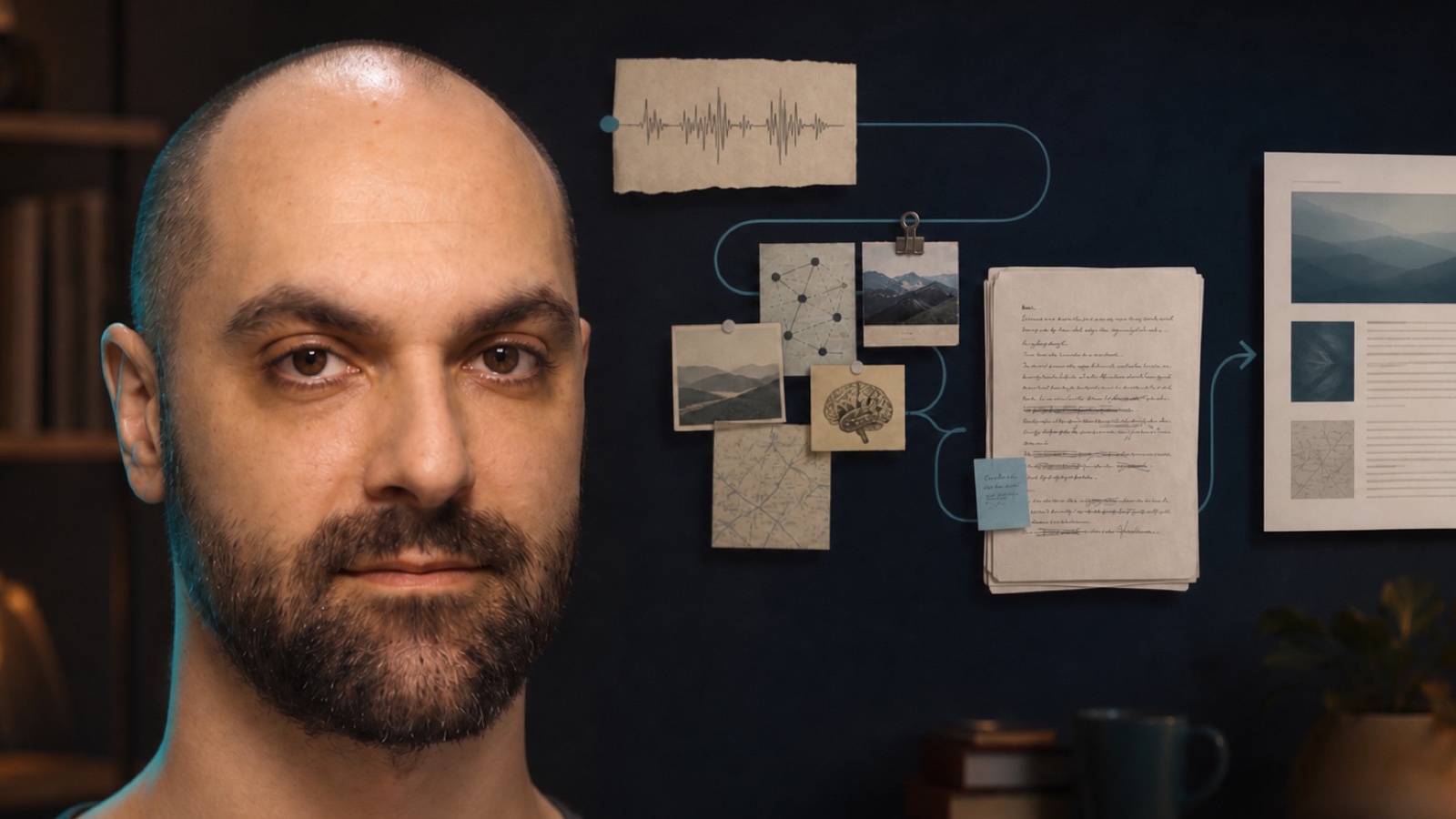
The cover image is a synthetic editorial illustration created to represent a human manuscript inside a research and validation system.
Open conversation
Continue the conversation
Disagree, spot a gap, or have an experience that adds to the subject? You can comment without creating an account or use one of the available sign-in methods. New comments may be moderated; when published, they are public. Do not publish personal data, credentials, or sensitive information.
When comments load or are submitted, technical data may be processed as described in our privacy policy. Privacy.