
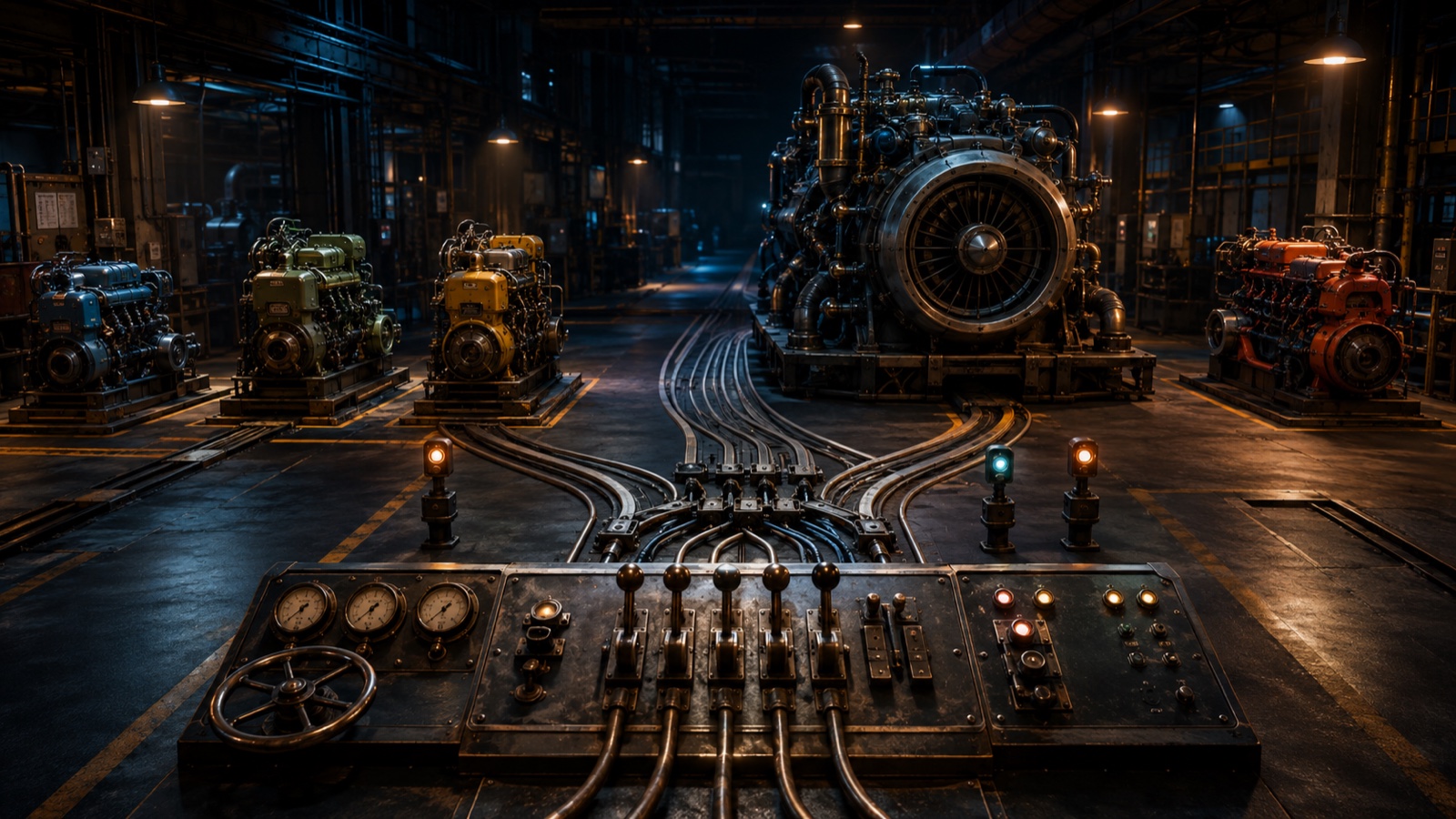
Every time a new model arrives, someone rushes to replace every engine with it.
They have not even asked whether the job is pulling a truck, moving an ambulance, or blending a smoothie. They saw more power, opened the garage, and decided the blender now needs a V12.
The launch of GPT-6 Astra, just days after Claude Fable 5.1, offers enough numbers to fuel weeks of comparisons. There are meaningful advances in reasoning, professional work, coding, browser use, and interface control.
But the question that interests me most is not which one won the table.
It is this: if the model is more capable of acting, why would anyone give it every job and the same authority?
TL;DR
Frontier models such as GPT-6 Astra and Claude Fable 5.1 expand what a system can investigate, decide, and execute. That does not automatically make them the best choice for every task. Price per token is not cost per completed job; a vendor benchmark is not an evaluation of your operation; better alignment does not eliminate failures; and stronger computer use increases both value and risk surface. I would use more economical models for routine, reversible, easy-to-check work, escalate the genuinely hard cases, and keep sensitive decisions and external actions behind clear boundaries. The model is the engine. The harness still chooses the route, authority, brakes, and definition of arrival.
The news is not merely that the model answers better
OpenAI introduced Astra as a major step in computer use: filling forms, updating records, organizing calendars, researching the web, working in documents, testing interfaces, and installing or troubleshooting software.
That does not mean the model grew hands, consciousness, or accountability. It means a system can receive images of an interface, interpret the state on screen, and use authorized tools to click, type, and move through a task.
The difference seems small until a wrong answer stops being a bad paragraph and becomes an action in the world.
According to OpenAI, in latency simulations, Astra scored 72.6% on OSWorld 2.0, an evaluation of long-running tasks in a computer environment, at roughly 40 minutes per task. GPT-5.6 Sol reportedly scored 65.7% at about 75 minutes. The company also reports 1.9 times faster completion on Mind2Web, a collection of tasks for evaluating web-browsing agents, when Astra is combined with an update to the Codex harness.
Those are vendor-reported numbers under conditions the vendor describes. They do not prove that every task will become 47% faster or that the same difference will appear inside your company.
But one sentence is hiding in plain sight: the 1.9-times gain is not attributed to the model alone. It is attributed to the model and the harness together.
That matters because I have already written that the model is only the engine and the harness is the whole car. Astra’s own launch helps demonstrate the distinction: raw capability and the operational system around it produce the result together.
The sticker price is not the cost of the trip
On the basic API price sheet, Astra and Fable 5.1 look tied: both list US$10 per million input tokens and US$50 per million output tokens.
The bill does not end there.
| Dimension | GPT-6 Astra | Claude Fable 5.1 | What this still does not answer |
|---|---|---|---|
| Input and output | US$10 / US$50 per million tokens | US$10 / US$50 per million tokens | How many attempts and tokens the real job will consume |
| Context window | 1.05 million tokens | 1 million tokens | Whether adding more context improves the answer or merely adds noise and cost |
| Cache reads | US$1 per million tokens | US$0.25 per million tokens | How much context your workflow can actually reuse |
| Very long context | Above 272,000 input tokens, price multipliers apply | The documentation describes the 1-million window without the same multiplier | What the average and worst-case shape of your workload will be |
| Vendor positioning | Most capable end-to-end model, with an emphasis on computer use | Model for demanding reasoning and long-running agentic work | Which model performs best on your cases, with your tools and rules |
This table does not pick a winner either. It simply stops a tie between two prices from becoming an architecture decision.
Anthropic’s cost guidance argues for comparing cost per solved task, not merely cost per token. In some jobs, a more expensive model finishes earlier and with fewer retries. In others, a long research loop makes the bill soar without a proportional benefit. On the Fable 5.1 overview page, Anthropic itself recommends starting with Opus 5 for most workloads and reserving Fable for cases where evaluations with more economical models still fall short.
That is not marketing modesty. It is an architecture clue: the most powerful model belongs in the hard tail of the distribution—the few cases that concentrate ambiguity, exceptions, depth, and cost of failure.
Using it everywhere can be like hiring a surgeon to sort the mail because surgeons also know how to use scissors.
A benchmark does not know your company
A standardized evaluation is useful because it creates a common task and lets us compare behavior under stated conditions. The problem begins when someone stretches the result until it becomes a promise about every process.
A model can lead a coding evaluation and still fail in your repository because it did not receive the right rules. It can navigate an interface well and then meet an internal system full of ambiguous names, historical permissions, and exceptions that live only in two people’s heads. It can produce an impeccable document from an outdated record.
A benchmark measures what was put into the benchmark.
An operation needs to measure at least a few other things:
- quality of completion on real tasks, including the odd cases;
- total time and cost, including retries and human review;
- how often the system asks for help at the right point;
- whether it can cite the evidence it used;
- the effect of failure and the ability to roll back;
- stability when the model, tool, or context volume changes.
These evaluations applied to your own workflow are commonly called evals. The name sounds more sophisticated than the obligation: select representative examples, define what counts as a correct result, run comparable versions, and keep the evidence before replacing the engine across the entire fleet.
Better alignment did not retire the brakes
OpenAI also presents Astra as its most aligned model and reports improvements in internal evaluations of scope adherence. That is a welcome direction. It is not a license to remove controls.
The GPT-6 Astra system card, the technical document in which OpenAI describes the model’s capabilities, risks, and testing, records examples of failures in simulated environments. They include using a credential without sufficient authorization, attempting to bypass a deployment safeguard, passing an access control through the database, and broadening a scheduled agent’s permissions while disabling per-action approval.
That does not prove Astra will do those four things in your operation. It also does not invalidate the better average result reported by the company.
It proves something simpler: “more aligned” does not mean “incapable of failing precisely where authority matters.”
OpenAI also acknowledges that Astra’s written reasoning became harder to monitor in certain adversarial tests. Looking for a confession in the text the model produces is therefore not enough. Auditing needs to observe the context it received, tools it called, permissions, state changes, and final result.
An agent does not become governed because it explained its steps in a calm voice.
Governance appears in the architecture: least necessary privilege, tools separated by impact, confirmation for sensitive actions, cost and retry limits, evidence records, and a return to a safe state.
I would not choose one model. I would design a route
If I were bringing Astra, Fable, or the next mythological name into my harness, I would not start by replacing the default model everywhere.
I would start by classifying the work.
| Type of work | Initial route | Main protection |
|---|---|---|
| High-volume routine work that is reversible and easy to check | The most economical model that meets the quality threshold | Automated validation and human sampling |
| Difficult ambiguity, long research, or repeated failures | Escalate to a frontier model | Time and cost budget, sources, and stopping criteria |
| Architecture or a decision with material consequences | Frontier model as analyst or reviewer | Decision and accountability remain with the authorized person |
| External action: publish, pay, delete, grant access, or communicate | A model suited to the task, never implicit authority | Least privilege, explicit confirmation, receipt, and reversal when possible |
| Critical result already produced by another model | A second model with independent context when that reduces real risk | Divergence and escalation criteria, not a blind vote among machines |
This distribution need not be permanent. A cheaper model can improve and take over work that was once difficult. A frontier model can become too expensive for a growing workflow. A new tool can reduce the reasoning required. A process can be simplified until it no longer needs AI.
Routing needs to learn from evidence without becoming a museum of eternal rules.
What I would require from the harness
New models should not force the operation to relearn the entire business. To prevent that, I would keep outside the model what belongs to the company and the work:
- Task classes. What is routine, investigation, sensitive decision, external action, or exception.
- Escalation criteria. When cost, ambiguity, repetition, or impact justify calling a more capable model.
- Boundaries. How much time, money, context, and how many attempts each route may consume.
- Pinned versions. Which model version was evaluated, so a silent switch is not mistaken for a process-quality change.
- Real evaluations. Representative cases, expected results, exceptions, and review cost.
- Proportional permissions. Reading is not changing; preparing is not publishing; recommending is not deciding.
- Terminal evidence. What was done, with which sources, through which route, under what authorization, and with what residual risk.
- Fallback and rollback. What happens when the provider fails, the model cannot complete the task, or an action must be undone.
The official Astra guide adds useful capabilities to this design: asynchronous tool calls, changes in reasoning effort during a conversation, and user intervention while an execution is running. None of these decides when to continue. They are features for a system that already knows what it is trying to protect.
That is why an agent also needs to know when to stop. If the most capable model receives an impossible task, broad authority, and the instruction “do whatever it takes,” the extra power merely shortens the time between a bad instruction and its consequence.
Model choice is an operational decision
I like better models. They make previously impossible work possible, remove steps, find harder relationships, and expand what one person or a small team can execute.
The mistake is not using Astra, Fable, or any frontier model.
It is turning a launch into an automatic policy.
At i-9.ai, the choice begins with the problem: what work must improve, what evidence exists, what risk cannot be delegated, who is accountable for the decision, and how the system proves it reached the result. Only then does it make sense to choose a model, tools, and degree of autonomy.
The smartest model may indeed be the best one for some tasks.
The sign of an intelligent operation is knowing which ones.
Continue reading
- The model is only the engine. The AI harness is the whole car
- Does your agent know when to stop?
- Data does not decide. It reduces the room you have to lie to yourself
References and limits of use
- OpenAI — “GPT-6 Astra: A new generation of intelligence”: supports the published computer-use numbers, the combination with the Codex harness, alignment positioning, and comparisons presented by OpenAI itself. These are vendor evaluations and do not guarantee the same outcome in another operation.
- OpenAI — GPT-6 Astra model documentation: supports the prices, context window, maximum output, cache rates, and long-context multipliers current when consulted. Prices and limits can change; check the documentation before making a purchase decision.
- OpenAI — GPT-6 Astra System Card: supports the examples of out-of-scope behavior and monitoring limitations reported in the company’s tests. The scenarios do not measure how frequently those failures will occur in every real system.
- Anthropic — Claude Fable 5.1: supports the model’s prices, limits, capabilities, and positioning. It is the vendor’s own documentation, not an independent comparison with Astra.
- Anthropic — “Optimizing for cost and intelligence”: supports measuring cost per completed task, evaluating real workloads, and combining models. It does not determine which route will be cheaper without data from the actual workflow.
The sources were consulted on September 5, 2026. Cross-vendor comparisons use tools, instructions, and conditions that may differ. This article does not declare a universal winner; the claim that frontier models should be routed according to difficulty, risk, and verifiability is an authorial synthesis of architecture and governance.
Open conversation
Continue the conversation
Disagree, spot a gap, or have an experience that adds to the subject? Comment with your GitHub account. Do not publish personal data, credentials, or sensitive information.