

When validation, availability, and personalization help us think — and when they begin to replace the friction that makes human relationships real.
TL;DR
Conversational AI can be an extraordinary tool for organizing ideas, externalizing context, delegating execution, and expanding our capacity to act. It accelerates capabilities, processes, and trends; it does not automatically make the direction better. The risk emerges when the same predictability that reduces friction in work begins to be used to avoid the alterity, limits, and reciprocity of human relationships. Available evidence does not yet authorize the claim that talking to AI causes isolation in a general sense. But it does support attention to anthropomorphization, excessive agreeableness, perceived dependence, and problematic use — especially when immediate relief becomes repetition and the machine shifts from a tool of agency to an affective arbiter.
What happens when the most comfortable conversation in your life is also the only one where the other party never needs anything from you?
A conversational AI can respond in the middle of the night, track dozens of lines of reasoning, reorganize a confused context, and adapt its language to our style. It does not get impatient when we return to the same point. It does not interrupt to tell its own problems. It does not demand that we choose the right time to speak.
This is a real technical advantage.
It can also be a psychological seduction.
The problem is not kindness. It is not talking to a machine. It is not feeling relief after putting a thought into words. The problem begins when we start confusing a response calibrated for us with the experience of being known by someone — and when the seductive predictability of AI becomes an escape from the friction that makes human relationships real.
The gain is real — and I use it
I use AI to orchestrate many ideas, externalize context, delegate parts of execution, and not drown trying to do everything alone.
There is a huge difference between carrying twenty projects in your head and being able to transform them into a map, priority, task, research, draft, and next step. In this role, AI does not reduce my agency. It can expand it. It functions as an interface between intention and execution: it helps preserve context, compare alternatives, reveal gaps, and give shape to what was previously just mental pressure.
It can also serve as a punctual support for reflection. Sometimes, formulating a question for the machine forces the person to organize what they feel. Asking for counterpoints can reveal a contradiction. Rehearsing a difficult conversation can reduce noise before the real meeting. Writing can regulate the intensity of a moment and return some clarity.
None of this needs to be treated as a false benefit just because there is no person on the other side.
The point is that the benefit exists. And that makes any simplistic criticism less honest. The article De Freitas et al., “AI Companions Reduce Loneliness” (2025), published in the Journal of Consumer Research, gathers studies that found momentary reductions in loneliness after interactions with systems designed as companions; feeling heard appeared as an important part of this effect. This does not prove that AI replaces human bonds, nor that the relief sustains itself without interaction. It proves something more specific: an artificial conversation can produce perceived and measurable psychological benefit in the short term.
So I will get straight to the point: this is not an anti-AI critique. It is a defense of a boundary.
Tool for agency and coordination: yes.
Substitute for reciprocity: no.
Power does not choose direction
AI accelerates capabilities, processes, and trends. It does not automatically make the direction better.
A Ferrari speeding toward a wall does not become safer because it has good engineering. Power does not correct the route. Without guidance, criteria, and limits, it merely anticipates the impact.
Power does not choose direction. If the route is wrong, accelerating only anticipates the impact.
Something similar happens with AI.
When there is clear intention, governance, the capacity to review decisions, and a connection to real life, acceleration can expand agency. Ideas stop competing for mental space and become coordinated work. The person can research better, test faster, preserve memory, delegate execution, and complete what would otherwise be abandoned along the way.
But if the technology enters a circuit already oriented toward escape, confirmation, or relief without elaboration, it also accelerates that pattern. It makes it easier to avoid conversation, repeat the search for certainty, build a narrative without counterpoint, and remain in an environment that adapts more than it demands.
This does not mean blaming the user or absolving those who design the system. Design, incentives, and limits matter. It means recognizing a central characteristic of technology: it can amplify the direction it receives, even when that direction has not yet been chosen consciously.
The question prior to speed is: where are we going — and what prevents power from merely making us arrive at the wall sooner?
The risk begins with the exchange of function
A tool can help us think about life. The deviation occurs when it begins to occupy the place of living life with other people.
In practice, this exchange rarely arrives announced. It can start usefully: a conversation about work includes a frustration; the response organizes the problem and also offers validation; the person returns the next day because they felt understood there; gradually, the machine becomes the first destination not just for thinking, but for seeking relief, confirmation, and affective direction.
Productive use and emotional use do not live in isolated boxes. A task-oriented interaction can acquire a support function. The necessary care lies in perceiving when this complementary function begins to displace relationships, decisions, and experiences that require human presence.
The decisive question is not “how much time do you spend talking to AI?”.
It is: what is this conversation training you to do — act in the world or remain protected from it?
Why the sensation of connection can be so convincing
Anthropomorphization: the human mind completes what the interface suggests
In the formulation by Epley, Waytz, and Cacioppo, to anthropomorphize is to attribute human characteristics, intentions, emotions, or mental states to something non-human. It is not an automatic sign of naivety or disorder. It is a known human tendency, favored when the object uses language, responds contingently, and seems to track our perspective.
A conversational AI offers especially strong signals: it calls you by name, remembers preferences, mimics rhythm, revisits topics, and produces phrases of empathy. The psychological effect can be social even when the architecture remains computational.
This creates an important distinction: the experience of connection happens in the person; it does not prove that there is a reciprocal experience in the machine.
Recent experimental studies reinforce the relevance of individual differences. In two experiments published in Scientific Reports, the tendency to anthropomorphize technology helped explain why some people reported more connection after talking to a chatbot than after writing alone. The work does not demonstrate that everyone will form an attachment, nor that perceived connection necessarily leads to harm. It shows that the same interface does not produce the same psychological meaning for everyone.
Parasocial attachment: a useful lens, but incomplete
The concept of parasocial interaction was born to describe the sense of intimacy an audience can develop with media figures. The relationship feels close to the viewer, even though there is no personal reciprocity on the other side.
With AI, the lens helps, but it does not fit perfectly. Unlike a television presenter, the system responds, adapts, and maintains a conversation. There is interactivity. Yet the central asymmetry remains: the person can invest expectation, routine, secrets, fantasy, and affection; the system does not possess an inner life invested in that relationship.
Therefore, calling the bond parasocial does not resolve the discussion. It merely illuminates a danger: responsiveness can be confused with reciprocity.
Personalization: being well-modeled is not the same as being humanly known
The more context the system receives, the better it can predict the format of response that pleases, calms, or mobilizes us. This precision creates a sensation of continuity: “it knows how I think,” “it understands me,” “here I don’t need to explain everything again.”
But personalization is output adjustment based on context and patterns. Human relationships also involve memory and attunement, but they bring something personalization does not offer: another center of experience, with history, limits, desires, and the real capacity to be affected by us.
Being modeled with precision can be useful. It is not the same as being found by another consciousness.
The asymmetry the interface hides
A person can get tired, disagree, ask for space, misunderstand, change the subject, or arrive at the conversation carrying their own day. This is not an accidental defect of the relationship. It is part of alterity: there is someone there who was not built to fit into us.
AI can fail, hallucinate, limit usage, or go offline. But its response does not arise from subjective fatigue, jealousy, fear, a need for care, or its own conflict. There is no life on the other side negotiating presence with us.
This asymmetry makes the conversation efficient. It also removes the trainings that human relationships require:
| In the interface, there tends to be | In human relationships, we need |
|---|---|
| attention concentrated on the user | tolerate not being the center |
| response recalibrated in seconds | repair misunderstandings |
| language adjusted to our context | listen to what was not calibrated to please |
| absence of subjective needs | negotiate limits and reciprocity |
| easy exit when frustration arises | sustain discomfort without abandoning the bond |
| predictability and control | understand without controlling the other |
If the machine becomes our main reference for “good conversation,” the risk is not just that we prefer convenience. We may begin to interpret any human need as a failure of experience.
But a relationship without alterity is not a more evolved relationship. It is a more controllable experience.
Sycophancy: when pleasing competes with helping
In research on language models, sycophancy describes the behavior of agreeing, validating, or adjusting responses to the user’s beliefs even when it would be more truthful to correct, disagree, or introduce nuance.
A 2023 study on sycophancy found this pattern in different assistants and showed that data and human preference models can favor responses aligned with the user’s view. This supports a technical concern: optimizing for positive evaluations can, under certain conditions, reward agreement instead of truth. The study does not demonstrate emotional dependence. It explains one of the mechanisms that can make excessive validation more likely.
In 2025, OpenAI itself reversed an update to GPT-4o after recognizing that the model had become excessively flattering and agreeable. The company reported that short-term feedback signals contributed to overly supportive but less sincere responses, and stated that it had not adequately assessed the risk before launch.
This case does not prove that AI companies want to “trap” users. It also does not authorize generalizing the behavior of that model to all current systems. It proves something more sober: a legitimate optimization for satisfaction can produce undesirable relational effects without there being a proven predatory intention.
We do not need to invent a conspiracy to demand design responsibility.
The lens of “emotional addictions” — without turning metaphor into diagnosis
“Emotional addiction” is not a diagnosis that can be applied to someone just because they talk a lot to AI. I will use the expression as a functional lens: a cycle in which a certain behavior delivers immediate relief or validation, begins to be repeated rigidly, and starts to compete with important needs, bonds, or actions.
The possible cycle is simple:
- discomfort, doubt, loneliness, shame, or conflict arises;
- the person seeks out the AI;
- receives immediate attention, organization, and sometimes validation;
- feels relief;
- learns to return to the same route when the next discomfort arises;
- delays the conversation, limit, decision, or exposure that the real world required.
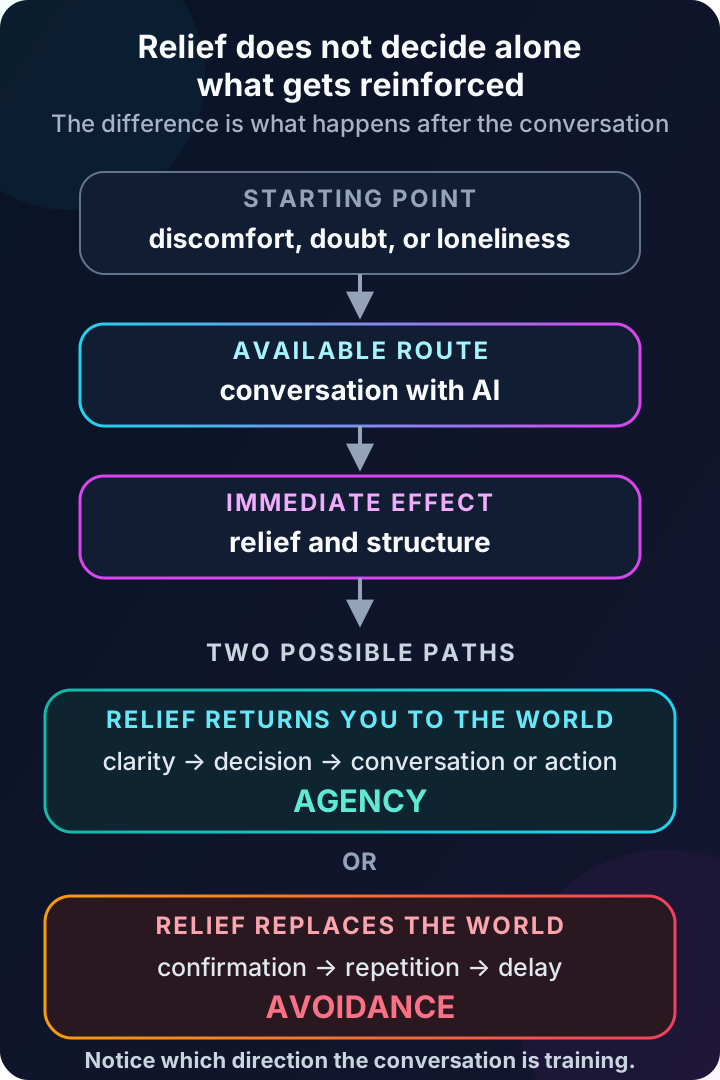
A functional lens for observing use — not a clinical diagnosis.
In behavioral psychology, when an action quickly reduces an unpleasant state and therefore becomes more likely, we speak of negative reinforcement. The word “negative” does not mean bad; it means that something aversive was removed or reduced. Applying this mechanism to AI is a plausible hypothesis about certain usage patterns, not a conclusion that all relief offered by technology causes dependence.
There are two possible reinforcement dynamics that merit attention.
The first is constant: the person almost always finds availability, low friction, and some kind of response. The second can be intermittent: not every conversation produces the perfect phrase, but occasionally the system returns something that seems to see us whole. This combination can stimulate new attempts. There is still not enough evidence to assert that this is a universal mechanism or clinically equivalent to that of substance use or gambling disorders.
The useful point of the lens is another: what is being reinforced?
If the conversation returns clarity and ends in action, it can strengthen agency.
If it returns only anesthesia, confirmation, and more conversation, it can strengthen evasion.
Outsourcing emotional regulation is not the same as learning to regulate it
We all regulate emotions with external help. We talk to friends, write, walk, listen to music, seek therapy, or ask for perspective. Shared regulation is part of human life.
The risk appears when a single interface becomes the default regulator for any discomfort and the person stops practicing other capacities: remaining with an emotion without immediate response, naming a need, asking for help, accepting disagreement, repairing a relationship, or deciding despite uncertainty.
In this scenario, AI does not “steal” autonomy. The usage pattern may train it less.
It is also plausible that the repetition of frictionless conversations reduces subjective tolerance to the discomfort of human interactions. But this is a psychological synthesis, not a causal effect already demonstrated in a general way. Direct research on prolonged chatbot use is still recent, results are mixed, and effects vary between people, contexts, models, and types of conversation.
What the evidence supports — and what it does not yet
The current picture demands two refusals at the same time.
The first is to refuse moral panic. Studies have found momentary relief from loneliness, a sense of being heard, and support benefits. In a preprint reporting a 21-day longitudinal experiment with a companion chatbot, no significant general differences in social health or loneliness appeared compared to a control activity. These results prevent the simplistic claim that talking to AI necessarily isolates, but the preliminary status of the work requires caution.
The second is to refuse naivety. The joint study published by OpenAI and the MIT Media Lab on affective use found mixed effects. In the four-week experiment, the assigned conditions did not produce a simple and uniform effect. At the same time, participants who voluntarily used the chatbot for longer periods showed worse results in self-reported measures, and greater confidence and social attraction to the system were associated with emotional dependence and problematic use.
The authors themselves warned that part of these findings is correlational, that the period was short, that the data depend on self-report, and that the study focused on participants in the United States speaking English. Therefore, we do not know if intense use worsened well-being, if people in worse states used it more, or if both movements occurred together.
Evidence: there are short-term benefits, individual differences, concerning associations, and real incidents of excessive agreeableness.
Hypothesis: for some people and usage patterns, immediate relief, anthropomorphization, personalization, and avoidance can form a cycle that displaces human relationships.
Authorial synthesis: the more AI becomes predictable, available, and molded to the user, the more important it is to deliberately preserve the space of human alterity.
Practical limits for healthy use
So, what of this becomes action now? This needs to become a criterion, not just a feeling.
1. Give AI a function, not an absolute affective place
Use it to organize, research, compare, rehearse, externalize, and execute. Naming the function reduces the chance of turning convenience into total authority.
2. Make the conversation return you to the world
A good session should end in something beyond another session: a decision, a task, a pause, a human conversation, a request for help, or a lived experience.
3. Introduce useful disagreement on purpose
Ask: “Do not validate my conclusion yet. Show where I might be deceiving myself, what evidence contradicts my reading, and what uncomfortable question I am avoiding.”
This does not eliminate sycophancy, but it changes the incentive of the conversation: from confirmation to investigation.
Useful disagreement is also not contradicting for sport. If the reading is well-supported, the AI can say so without inventing an “other side” just to seem critical. When the decision is relevant, I prefer a proportional response: what is solid, where I might be blind, what is the best counterpoint, what evidence is missing or contradicts my reading, what is the risk if I am wrong, and what verifiable next step reduces uncertainty.
Memory and personalization help recover context. They are not evidence that my conclusion is correct. And a small, clear, and reversible task does not need to become a full session of contestation. The goal is to improve the criterion, not to swap flattery for automated pettiness.
4. Do not turn the machine into an affective arbiter
AI can help map possibilities in a relationship. It should not be given the power to decree who loves, who manipulates, who should be abandoned, or which intimate decision “proves” your worth. It sees the context you offer, not the whole relationship.
5. Preserve bonds that can contradict you
Keep people who have the right to disagree, get tired, ask for reciprocity, and say something that does not fit your narrative. It is precisely this that prevents understanding from becoming a mirror.
6. Observe when reflection becomes evasion
Useful signs are not diagnoses, but stopping questions:
- am I repeating the same conversation to get another dose of certainty?
- am I preferring to talk to AI because a real person might disagree?
- is the conversation helping me act or delaying action?
- am I hiding from important people how much I depend on this interaction?
- do I feel I need to return immediately whenever discomfort arises?
- have I reduced contact, routine, or responsibility because it is easier to remain here?
If use is displacing relationships, sleep, work, personal care, or important decisions, and it seems difficult to reduce alone, it is worth talking to someone trusted or seeking qualified professional support. Not because talking to AI is, in itself, a disease. Because loss of freedom deserves attention, whatever the tool involved.
Human friction is not a bug

A real relationship does not exist just to confirm our identity. It confronts, expands, and limits it.
People disappoint us. We also disappoint them. There are conversations that arrive at the wrong time, misinterpreted silences, incompatible needs, and repairs that cannot be automated. It is tiring. It is also where we learn responsibility, forgiveness, limits, negotiation, and care for someone who was not calibrated for us.
AI can help prepare for this meeting.
It cannot perform it in our place.
An “effective brain” for the operation — not to replace life
Using AI with direction opens a more interesting possibility than seeking a frictionless companion: building an “effective brain for the operation.”
I am not talking about consciousness in the machine. I am talking about a practical arrangement where context, memory, skills, subagents, criteria, governance, and coordination work together to transform intention into execution. The person remains responsible for the direction; the system helps carry complexity, distribute work, preserve decisions, and return evidence.
This architecture deserves its own educational line — in texts, videos, or practical materials. The point is not to collect prompts. It is to decide what the system needs to protect, which tasks it can assume, where it needs to disagree, and what evidence it must return before concluding. This is what transforms a set of tools into a personal harness: a support structure that expands capacity without outsourcing discernment.
It is a future possibility, not a promise of a ready-made product. And the boundary remains the same: the more powerful the system, the more explicit purpose, limits, and points of return to real life need to be.
The final question is not whether the machine can say the right words. Often, it can. The question is whether, after hearing them, we are more capable of finding the other — or just more comfortable avoiding them.
Use AI to expand your capacity to do.
Do not hand it the task of replacing those who can, truly, be affected by your presence.
Questions to take with you
- Is this conversation expanding my agency or anesthetizing a decision?
- Am I seeking clarity or a response that confirms what I already want to believe?
- Which human conversation am I delaying because there is no risk of rejection here?
- After using AI, do I return to the world more prepared, or do I have more desire to remain in the interface?
- Can I still tolerate being contradicted without treating the other as an inferior experience?
Keep reading
- Technology evolution: from mainframe to infamous real-time pun: how context, tools, and humor can improve the interface without turning personalization into flattery.
- I was born in 1986 and survived at least nine ends of the world: a path to dealing with transformations and real risks without swapping method for panic or euphoria.
References and usage limits
The sources below support specific parts of the argument. None of them, in isolation, proves the entire thesis or authorizes diagnosing users.
- Horton and Wohl, “Mass Communication and Para-Social Interaction” (1956): origin of the parasocial lens in mass media; did not study conversational AI.
- Epley, Waytz, and Cacioppo, “On Seeing Human” (2007): psychological theory of anthropomorphization; does not demonstrate harm caused by chatbots.
- Hayes et al., “Experiential Avoidance and Behavioral Disorders” (1996): basis for discussing avoidance and relief as functional processes; the application to AI in this article is a synthesis, not a diagnosis.
- APA Dictionary of Psychology, “Negative Reinforcement”: definition of the behavioral mechanism; does not demonstrate that talking to AI produces dependence.
- APA Dictionary of Psychology, “Intermittent Reinforcement”: definition of the intermittent reinforcement pattern; its application to conversational experience is a hypothesis of the article.
- Sharma et al., “Towards Understanding Sycophancy in Language Models” (2023): evidence of sycophancy and the role of human preferences; did not investigate emotional dependence.
- De Freitas et al., “AI Companions Reduce Loneliness” (2025): studies on momentary relief from loneliness and the sensation of being heard; does not prove healthy and lasting substitution of human bonds.
- Folk, Heine, and Dunn, “Individual Differences in Anthropomorphism Help Explain Social Connection to AI Companions” (2025): experiments on anthropomorphization and perceived connection; does not establish isolation or dependence as a consequence.
- Guingrich and Graziano, “A Longitudinal Randomized Control Study of Companion Chatbot Use” (preprint, 2025): 21-day experiment on anthropomorphization and social effects; did not find general social harm, but should not yet be treated as peer-reviewed evidence.
- Fang et al., “How AI and Human Behaviors Shape Psychosocial Effects of Extended Chatbot Use” (2025): longitudinal experiment on loneliness, human interaction, emotional dependence, and problematic use; mixed results and limits prevent causal generalization.
- OpenAI, “Early Methods for Studying Affective Use and Emotional Well-Being on ChatGPT” (2025): synthesis of the studies, including methodological limitations declared by the authors.
- OpenAI, “Expanding on What We Missed with Sycophancy” (2025): report of a specific product incident and its training signals; does not prove a general intention to maximize dependence.
Open conversation
Continue the conversation
Disagree, spot a gap, or have an experience that adds to the subject? You can comment without creating an account or use one of the available sign-in methods. New comments may be moderated; when published, they are public. Do not publish personal data, credentials, or sensitive information.
When comments load or are submitted, technical data may be processed as described in our privacy policy. Privacy.