

After a few decades, one learns to distrust both the prophet of the apocalypse and the salesman promising lifetime immunity in twelve installments.
TL;DR
The “at least nine” in the title is a humorous estimate of popular waves of doomsday predictions that crossed my generation, not a scientific count. Y2K and 2012 show why skepticism needs nuance: the former involved a real technical problem mitigated by extensive work; the latter gathered catastrophic predictions without astronomical basis. AI does not fit into simple prophecy either. It is a concrete transformation, with benefits, uncertainties, and real risks. The antidote is neither panic nor euphoria: it is method, backup, and the next verifiable step.
I was born in 1986.
This means I had a childhood without Wi-Fi, a adolescence with dial-up internet, and an adult life where a machine can inspect a repository while I make coffee.
It also means I survived at least nine ends of the world.
Maybe seven. Maybe twelve. It depends on whether the count includes only dates marked on the calendar, waves of popular panic, technological predictions, suspicious comets, calendars interpreted with creativity, or every moment someone opened a presentation with the phrase “nothing will be the same.”
I do not keep an official spreadsheet of apocalypses. That seems like the kind of organization that might encourage the universe.
The number in the title is a bar tab with declared criteria: there were many waves, repeated enough for a generation to learn that rhetorical urgency and concrete risk are not the same thing.
Growing up among alarms produces antibodies
Those who went through the end of the Cold War, the turn of the millennium, predictions of colliders creating black holes, the 2012 Mayan calendar, Nibiru, prophetic moons, and other seasons of catastrophe gained a certain resistance to definitive headlines.
The first reaction becomes: “Okay. Does the world end before or after lunch?”
This humor protects against manipulation. It breaks the automatic authority of those who sell certainty about complex systems. It helps ask about mechanism, evidence, timeline, and economic interest before buying the full prophecy.
But antibody can also become allergy.
If every warning seems like alarmism, we start ignoring real risks. If every transformation seems like marketing, we notice the change only when it has already altered work, the market, or how we make decisions.
The goal is not to become immune to fear.
It is not to outsource judgment to whoever shouts the loudest.
Y2K was not just a joke that went wrong
Today it is easy to remember the millennium bug as a collection of dramatic reports, precautionary stockpiles, and computers that, in the end, did not start a global rebellion at midnight.
The technical problem, however, was real. Many systems represented the year with two digits and could interpret “00” as 1900. In operations calculating dates, due dates, benefits, interest, or service continuity, this created concrete risk.
The absence of collapse does not prove the concern was imaginary.
The U.S. GAO attributed the limited disruptions to leadership, cooperation, testing, corrections, and contingency plans, and later consolidated these lessons for other technological management challenges. In other words: many people worked so that the disaster would seem like an exaggeration afterward.
It is a frequent irony of good engineering. When prevention works, someone concludes it was never necessary.
Not every alarm that does not materialize was false. Sometimes, the calm outcome is evidence that method, investment, and contingency did the work.
2012 was another category
The supposed end of the world in December 2012 mixed the Mayan calendar, alignments, solar activity, magnetic inversion, and a planet called Nibiru that had an excellent name and poor documentation.
The NASA explained at the time that the Mayan calendar did not end; it closed a cycle and started another. There was also no astronomical evidence for the destroyer planet or for the other catastrophic mechanisms presented.
Here, the problem was not a known technical failure requiring coordinated remediation. It was a narrative that accumulated scientific elements without respecting what science supported.
Y2K and 2012 fit in collective memory as “ends of the world,” but they should not be used as if they were equivalent.
One teaches that serious preparation can prevent impact.
The other teaches that technical language does not turn imagination into evidence.
AI arrived dressed as prophecy
With artificial intelligence, both extremes appeared quickly.
On one side, the promise of automatic abundance: one-person companies, infinite productivity, knowledge without barriers, all work reinvented by next Tuesday.
On the other, the certainty of collapse: immediate end of professions, total loss of control, inevitable superior intelligence, and a straight line between any new model and the fate of civilization.
There are legitimate questions within these extremes. Automation can displace tasks and power. Systems can reproduce errors at scale. Models can invent answers, expose data, facilitate abuse, concentrate infrastructure, and induce confidence beyond evidence. Agents with tools increase the possible impact of a wrong interpretation.
There are also concrete gains. People can research, translate, program, review, organize context, and execute tasks that previously required more time, money, or coordination.
The problem begins when hypothesis becomes destiny and demonstration becomes proof of total transformation.
AI is not a new prophecy.
It is a rapidly evolving technology, applied by real institutions, under real incentives, in real systems. Precisely because of this, it deserves more method than mysticism.
Some revolutions arrive as a completed task
Important transformations do not always arrive with a siren, keynote, or soundtrack.
Sometimes, they arrive when you ask for a practical task and the machine delivers.
Not a pretty answer about what could be done. The delivery.
A file created in the right place. A research with verifiable sources. A reproduced bug. A reconciled spreadsheet. A video decomposed into scenes. A branch published with the diff you expected — and without the “spontaneous improvement” no one asked for.
At that moment, the discussion shifts from abstraction to capability.
You still need to check the result. You need to understand authorization, privacy, cost, error, and responsibility. But some operational frontier has already moved: an intention managed to cross context, tool, and execution with less intermediate work.
This type of change is silent enough to go unnoticed and concrete enough to alter processes.
It does not require believing the machine thinks like us.
It requires realizing it already does useful parts of the work with us.
Taking it seriously is not panicking
The NIST AI Risk Management Framework 1.0 treats AI risk as something to be governed, mapped, measured, and managed throughout the lifecycle. It is a less cinematic and more useful formulation.
Risk depends on context. A model summarizing public notes does not have the same impact as an agent altering production, recommending treatment, approving credit, or accessing private data. The same error rate can be inconvenient in a draft and unacceptable in an irreversible decision.
Before asking “is AI dangerous?”, it is worth asking:
- which system, version, and configuration are in use?
- what task does it perform?
- what data does it receive?
- what authority does it have?
- who verifies the output?
- what is the cost of an error?
- is there a rollback?
- what do we still not know?
Specific questions ruin grandiose predictions.
They also improve systems.
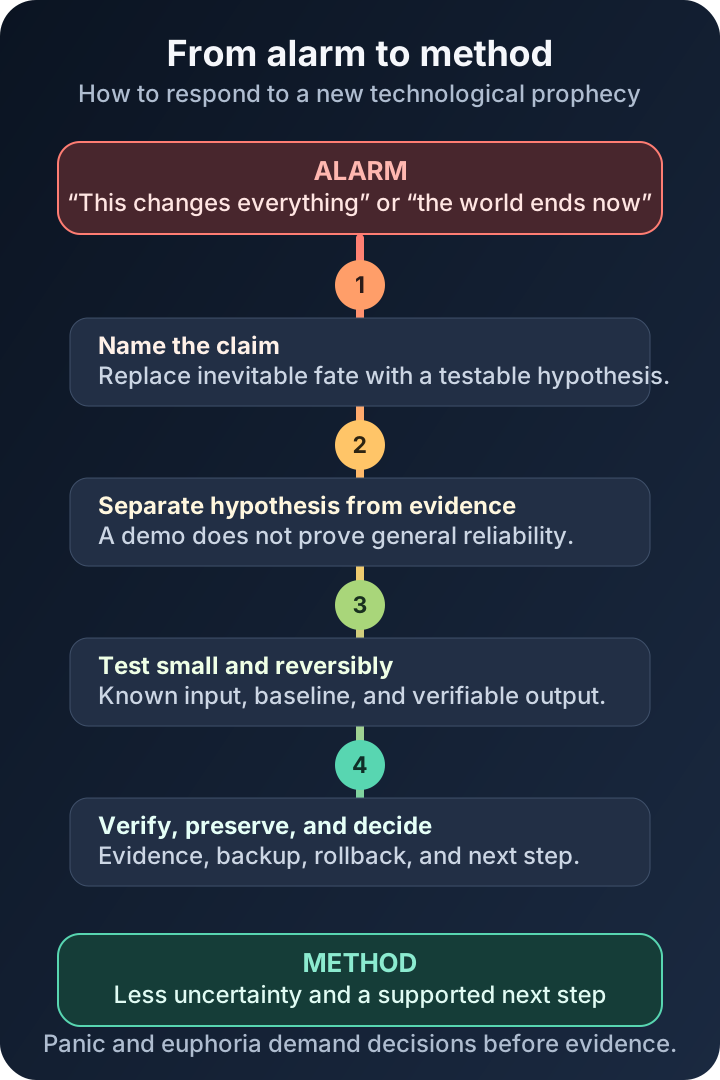
The antidote is method
When a new capability emerges, I prefer a simple protocol to automatic enthusiasm:
1. Name the claim
“This changes everything” cannot be tested. “This agent can prepare a draft according to these sources and criteria in twenty minutes” can.
2. Separate possibility from evidence
A demonstration shows that something happened once under specific conditions. It does not prove general reliability, economic viability, security, or suitability to your context.
3. Start small
Choose a reversible task, with known input and verifiable result. Preserve a human baseline to compare quality, time, and errors.
4. Verify the delivery
Do not evaluate only fluency. Check facts, files, logs, calculations, sources, diff, and external effects. When the cost of error increases, the proof must also increase.
5. Preserve output and return
Backup is not pessimism. It is freedom to experiment without turning every test into a marriage with universal data community.
6. Decide the next step
After the test, expand, adjust, stop, or discard. Do not keep an eternal pilot just because “AI” makes the budget more photogenic.
Panic demands a decision before evidence. Euphoria does too. Method accepts uncertainty and produces the next useful data point.
Backup is an operational philosophy
Backup appears in this text as practice and metaphor.
In practice, it means maintaining recoverable copies, preferably isolated when risk justifies it, and testing restoration — practices recommended by the joint CISA and MS-ISAC guide. A synchronized file that immediately replicates its deletion is not necessarily the recovery plan you imagine.
As a metaphor, backup means preserving options.
Before handing an operation to a new system, know how to go back. Before automating a decision, keep the record that allows auditing it. Before replacing a process, understand which human capability might disappear along with the old friction.
Speed without return increases dependency.
Experimentation with return increases learning.
Neither panic nor cynicism
Surviving multiple ends of the world can produce two caricatures.
The first person believes in every prediction because this time the charts look better.
The second rejects every transformation because previous predictions exaggerated.
Both escape the same responsibility: looking at the concrete case.
AI already alters tasks, interfaces, and coordination costs. We do not know precisely where each capability will find its limit, how regulations, business models, and social habits will evolve, or which second-order effects will be most important. Admitting this does not weaken the argument. It is the condition for treating it with honesty.
My skepticism is not for sleeping through the change.
It is for separating change from spectacle.
If a machine can take a real task, operate with context, produce an artifact, and return evidence, there is something to learn. If it fails convincingly, there is something to limit. If the result cannot be verified, there is still no basis for delegating the decision.
The future rarely respects the date set by the prophet.
Work, on the other hand, wins tomorrow.
Tomorrow the world might not end, but it is still worth making a backup.
Keep reading
- Technology evolution: from mainframe to infamous real-time pun: the line from mainframe to agents and what changes when language becomes interface.
- The seductive predictability of AI: how the same acceleration that expands agency can expand evasion when direction is missing.
References and usage limits
The article does not present “nine ends of the world” as an academic category or a complete inventory. The count is an authorial frame for heterogeneous popular waves. The sources below support only the specific cases and practices to which they are associated.
- U.S. GAO, “Year 2000 Computing Challenge: Leadership and Partnerships Result in Limited Rollover Disruptions” (2000): records Y2K errors, responses, and the role of coordination and preparation; does not support all alarmism produced at the time.
- U.S. GAO, “Lessons Learned Can Be Applied to Other Management Challenges” (2000): consolidates learnings from leadership, partnership, control, and technology management after the turn of the millennium.
- NASA JPL, “2012 — A Scientific Reality Check”: explains why the end of a Mayan calendar cycle and claims about Nibiru did not indicate an end of the world.
- CERN, “Are the LHC Collisions Dangerous?”: responds to public concerns about high-energy collisions and microscopic black holes; does not support the authorial count of “ends of the world.”
- NIST, “Artificial Intelligence Risk Management Framework 1.0”: voluntary structure to govern, map, measure, and manage AI risks in context; does not predict the total impact of the technology.
- CISA and MS-ISAC, “Ransomware Guide”: recommends offline and encrypted backups and regular tests of availability and integrity; the reference is operational, not a claim that backup solves all risk.
Open conversation
Continue the conversation
Disagree, spot a gap, or have an experience that adds to the subject? You can comment without creating an account or use one of the available sign-in methods. New comments may be moderated; when published, they are public. Do not publish personal data, credentials, or sensitive information.
When comments load or are submitted, technical data may be processed as described in our privacy policy. Privacy.