
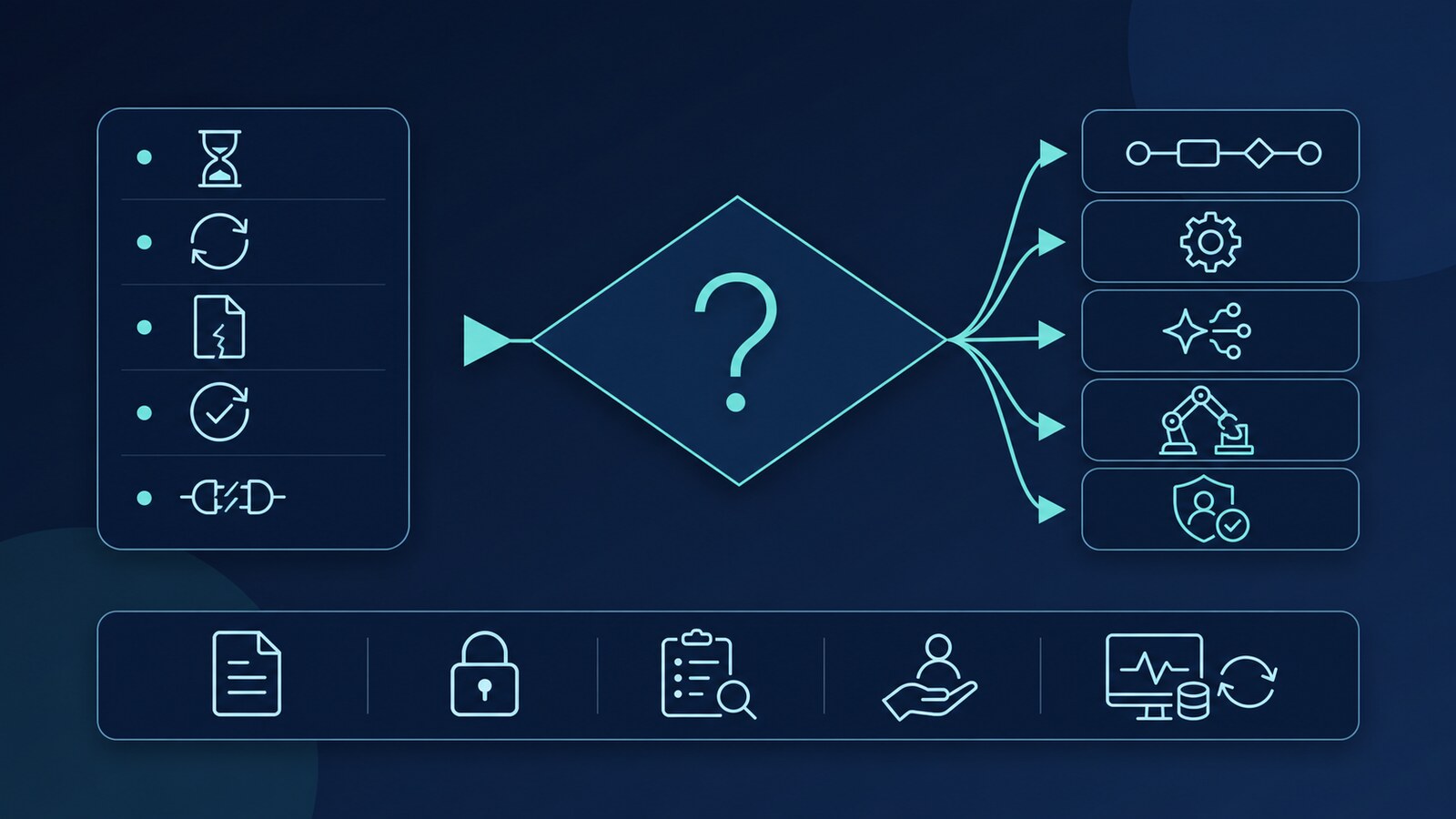
You need to find where work gets stuck — and choose the smallest intervention capable of making it move better.
TL;DR
I’ve noticed a recurring difficulty: many companies have already concluded that they need to use artificial intelligence, but they have no idea where to put it. The question arrives inverted. Instead of starting with the tool, I look for queues, rework, lost information, repetitive decisions, recurring errors, and people who have become manual integrations between systems. From the bottleneck, we can decide if the answer is to improve the process, create a deterministic automation, use AI as assistance, give tools to an agent, automate a limited operational decision, or preserve the human decision with better evidence. Not every problem needs AI. Every system needs responsibility, observability, and a safe way to fail.
One of the biggest challenges I see today is not convincing a company that artificial intelligence can be useful.
Many have already passed that stage.
The company has decided that it “needs AI.” The competitor is talking about it. The team has experimented with some chatbot. Someone saw an impressive demo. The board doesn’t want to be left behind.
The problem starts with the next question:
Where, exactly, do we put AI inside the company?
This is where the conversation usually becomes abstract. Because “putting AI” doesn’t describe a problem, a result, a decision, or a process. It only describes the desire to use a technology.
It’s like buying a machine before finding out which stage of the factory is stopped.
I prefer to invert the question.
Your company doesn’t need to start by figuring out where to put AI. It needs to find out where the work is getting stuck.
The bottleneck leaves clues
A bottleneck doesn’t always appear as a system down or a visible queue at a department’s door. Often, it disguises itself as normal routine.
It’s worth looking for places where:
- the same information is copied between spreadsheets, emails, and systems;
- a person spends the day asking if another person has finished a step;
- the client waits because no one found the necessary context to respond;
- documents arrive in different formats and someone needs to interpret them manually;
- the team repeats the same decision dozens of times, but the criteria remain only in the head of the decision-maker;
- an exception crosses several departments because the common flow doesn’t know what to do with it;
- known errors reappear without the system being able to detect them beforehand;
- the report is only ready when it has already lost part of its value for the decision;
- a person has become the human integration between tools that don’t talk to each other;
- the process depends on someone remembering the next step.
These signs don’t prove that the solution is AI. They show where there is coordination cost, waiting, repetition, context loss, or poorly supported decision-making.
This is the beginning of a true requirements gathering.
I don’t want to just hear “we need to automate finance” or “we want an agent for sales.” I want to understand what goes in, what needs to come out, who decides, what information supports the decision, which exceptions matter, what can go wrong, and who is accountable when it does.
Only then does it make sense to choose the technology.
Six possible answers — and AI is only part of them
When we find a bottleneck, I think in different levels of intervention. They don’t form a mandatory ladder. The right system can combine several of them.
1. Fix the process or integrate the systems
Sometimes it’s not a lack of intelligence. It’s a lack of a coherent flow.
If two tools already have reliable APIs and the transfer rule is clear, a traditional integration can solve it. If no one agrees on what a “ready order” means, the first task might be to define the process.
Putting AI on top of an ambiguity doesn’t eliminate the ambiguity. It just allows it to circulate faster.
2. Create a deterministic automation
When input, rule, and output are known, conventional code is usually the best answer.
“If the payment was confirmed, issue the document and update the status.”
We don’t need a probabilistic model to sum values, move a file, validate a mandatory field, run a backup, or notify that a deadline has passed.
Deterministic automation tends to be cheaper, more predictable, testable, and easier to audit. Using AI where a rule solves the problem doesn’t make the system more modern. It may just make the result less predictable.
3. Use AI as assistance
AI starts to make more sense when there is language, ambiguity, or volume that is difficult to handle with rules alone.
It can classify a request, summarize a history, extract fields from a document, compare texts, locate relevant knowledge, or produce an initial recommendation.
Here, AI does not execute the entire process. It reduces cognitive work and delivers better material for a person or automation to continue.
4. Give tools to an executing agent
An AI agent combines context, model, tools, and criteria to choose next steps within a delimited space.
It can query systems, gather evidence, fill an artifact, open a task, request missing data, run a validation, and return the current state with risk and next step.
The difference from a fixed automation is that the path can vary according to context. The difference from unrestricted autonomy is that tools, permissions, limits, and approval points remain explicit.
5. Automate a limited operational decision
It is possible to allow a system to make certain decisions without waiting for a person, but “decision-making AI” cannot be an elegant name for authority without an owner.
In market vocabulary, this may appear simply as decision-making AI. I prefer to explicitly state which operational decision was delegated and how far the system’s authority goes. The less exciting name forces the architecture to be more honest.
I would reserve this design for low-impact, reversible decisions delimited by clear policy. The system needs a value or consequence limit, a minimum confidence level, an audit trail, monitoring, an exception route, and a real possibility of undoing the result.
Routing a ticket to the most likely queue might fit here. Automatically releasing a small restock within stock, budget, and previously approved suppliers might also fit. Transferring a significant amount, firing a person, or silently assuming a legal risk, no.
6. Preserve the human decision and improve its evidence
In material decisions, AI’s greatest contribution may be organizing what the human needs to see.
The system gathers data, shows scenarios, records premises, points out missing information, compares alternatives, and exposes uncertainty. The person remains responsible for objective, context, ethics, and consequence.
As I wrote in The best answer is not the one that pleases me most, better organized data does not turn a conclusion into truth. It helps separate evidence, hypothesis, and impulse — provided the system also shows what it doesn’t know.
A practical map of bottlenecks and possible systems
The examples below are architectural hypotheses, not universal recipes or proven outcome cases. The same activity may require different designs depending on volume, risk, data, integrations, and responsibility.
On mobile, swipe the table sideways to compare system and control.
| Observed Bottleneck | Possible Fit | Control That Cannot Be Missing |
|---|---|---|
| Leads enter through various channels and wait until someone organizes the context | Integration to centralize; AI assistance to classify; agent to research history and prepare next contact | Consent, explicit commercial criteria, review of sensitive messages, and block of indiscriminate sending |
| Support repeats questions, looks for orders, and loses client history | Automation to recover status; AI to summarize; agent to query systems and propose or execute permitted actions | Human escalation, data protection, logging of queries, and clear limits for compensations or cancellations |
| Finance manually checks invoices, orders, and receipts | Deterministic rule for known reconciliation; AI to extract varied documents; agent to search for pending items | Segregation of duties, audit trail, and human approval before payments or relevant changes |
| Operations discovers stockout too late | Alert automation; AI assistance to estimate demand; agent to build restock proposal | Budget and quantity limits, approved suppliers, error monitoring, and approval for exceptions |
| Onboarding depends on a sequence of emails and reminders | Automation for accounts and checklists; AI to respond based on policies; agent to coordinate pending items between areas | Least privilege, access review, canonical source of policies, and human decision in hiring, evaluation, or termination |
| Knowledge is scattered in documents, conversations, and people | Semantic search and AI assistance to locate and summarize; agent to detect gaps and propose updates | Provenance, expiration date, access control, and human approval before changing the official source |
| Requirements come out of meetings and get lost before reaching execution | AI to structure speech and documents; agent to create artifacts, check project rules, and track validations | Scope owner as direction owner, traceability to source, and approval for relevant changes |
| Infrastructure produces too many alerts, backups exist but no one tests restoration | Automation for routines and tests; AI to group signals and explain context; agent to collect evidence and execute authorized playbooks | Minimum permissions, logs, rollback, isolated copies, restoration testing, and human decision for destructive actions |
This table is not for choosing a tool by row. It is for realizing that the same bottleneck can combine deterministic and probabilistic parts.
In support, for example, locating an order by number is integration. Summarizing twenty messages is AI assistance. Consulting order, policy, and history to build options is agent work. Authorizing a small refund within an explicit policy can be a limited automated decision. Changing a relevant commercial condition still requires a responsible person.
Calling all of this a “chatbot” would hide almost the entire architecture.
The bottleneck usually lives between departments
I learned early that no system exists only in code.
When I worked on-site at companies, solving a quick problem gave me time to get up, get coffee, and talk to other departments. In these visits, I started to understand how operations really worked: which information arrived incomplete, which rule wasn’t documented, where someone kept a parallel spreadsheet, and why an apparently simple order crossed so many people.
This curiosity remains part of my work.
A bottleneck may seem like a sales problem but be born in registration. It may appear in finance but start with a requirement that operations never recorded. It may become a support ticket because an integration failed silently three steps earlier.
That’s why my delivery doesn’t start or end with the prompt.
It crosses the entire pipeline:
- talk to those who live the process and gather requirements;
- observe the current flow and locate the real bottleneck;
- define result, criteria, decisions, exceptions, and risks;
- choose the smallest sufficient architecture;
- implement software, automations, agents, and integrations;
- place the system in the appropriate infrastructure;
- control access, protect data, and log actions;
- monitor behavior, cost, failures, and quality;
- design and test backup, restoration, and continuity of what needs to survive;
- review the system when operations change.
This path is not as cinematic as “installing an AI in the company.” It is much more useful.
Where I wouldn’t put AI
Knowing where not to use it is also part of the architecture.
I would be suspicious of a project when:
- the problem hasn’t been defined yet;
- the team wants to preserve a bad process just because they’ve always worked that way;
- the necessary data doesn’t exist, has no origin, or cannot be used that way;
- a simple rule would solve it with more predictability;
- no one accepts being the owner of the result;
- there is no way to measure if the bottleneck improved;
- a failure can cause significant damage and there is no review, containment, or rollback;
- the company wants to use AI to disguise a decision that remains human;
- the system would depend on too much authority for the expected benefit;
- the demo works, but no one knows how to maintain the operation afterward.
AI accelerates capacity, process, and trend. It does not automatically choose a better direction.
If the process is wrong, an agent may just cross it with more speed. The Ferrari still arrives at the wall earlier.
A script for the first conversation
If your company knows it needs to move forward but still can’t see where, these questions already change the quality of the diagnosis:
- Where is there a queue, rework, or recurring wait?
- What information does someone look for or copy every day?
- Which decision repeats and what criteria really support it?
- Which exceptions consume more time than the common flow?
- Where has a person become a manual bridge between systems?
- What needs to be deterministic and what involves language or ambiguity?
- What action could be executed by an agent — and with what authority?
- Which decision is reversible and low-impact enough to be automated?
- Where does the decision need to remain human, but can receive better evidence?
- How will we know that the bottleneck decreased?
- What will be logged, monitored, and reviewed?
- How does the system fail, go back, and recover its data?
Perhaps the final answer is an AI agent. Perhaps it’s an integration, an automation, a dashboard, a clearer policy, or the removal of a step that should never have existed.
The gain is in discovering this before buying the tool.
The conversation can start with the bottleneck
i-9.ai delivers software, automations, and AI-assisted systems from this end-to-end perspective: understanding the need, transforming requirements into architecture, implementing, integrating, publishing, monitoring, and protecting operations.
If you’ve realized that your company needs to use AI better, but still don’t know where it really generates value, get in touch. You don’t need to arrive with the solution or the chosen tool.
You can arrive with the bottleneck.
Keep reading
- AI is not one thing: model, agent, automation, and harness: a map of the layers that can compose the solution.
- The best answer is not the one that pleases me most: criteria for building agents that expose uncertainty and blind spots.
- ChatGPT already knows a lot about you. Before trusting it, make it prove it: how accumulated context becomes a hypothesis, interview, and verifiable contract for a harness.
- Generic agents can be your worst first contact with AI: why the real bottleneck and the company’s constraints must come before a ready-made solution.
- The evolution of technology: from mainframe to infamous real-time pun: how technical abstractions brought us to agents capable of tracking context and acting.
References and usage limits
- NIST, “Artificial Intelligence Risk Management Framework 1.0” (2023): voluntary structure to govern, map, measure, and manage AI risks. Supports the need to treat risk throughout the lifecycle; does not prescribe the architectures in this article or certify an implementation.
- Anthropic, “Building Effective Agents” (2024): presents the distinction used by the company between predefined flows and agents that dynamically drive the use of tools. It is an engineering reference, not a universal taxonomy.
The bottlenecks, systems, and controls presented here are hypothetical examples to explain architectural criteria. They are not case studies, complete sectoral recommendations, performance promises, or a substitute for technical, legal, labor, financial, or security analysis in the real context.
Open conversation
Continue the conversation
Disagree, spot a gap, or have an experience that adds to the subject? Comment with your GitHub account. Do not publish personal data, credentials, or sensitive information.